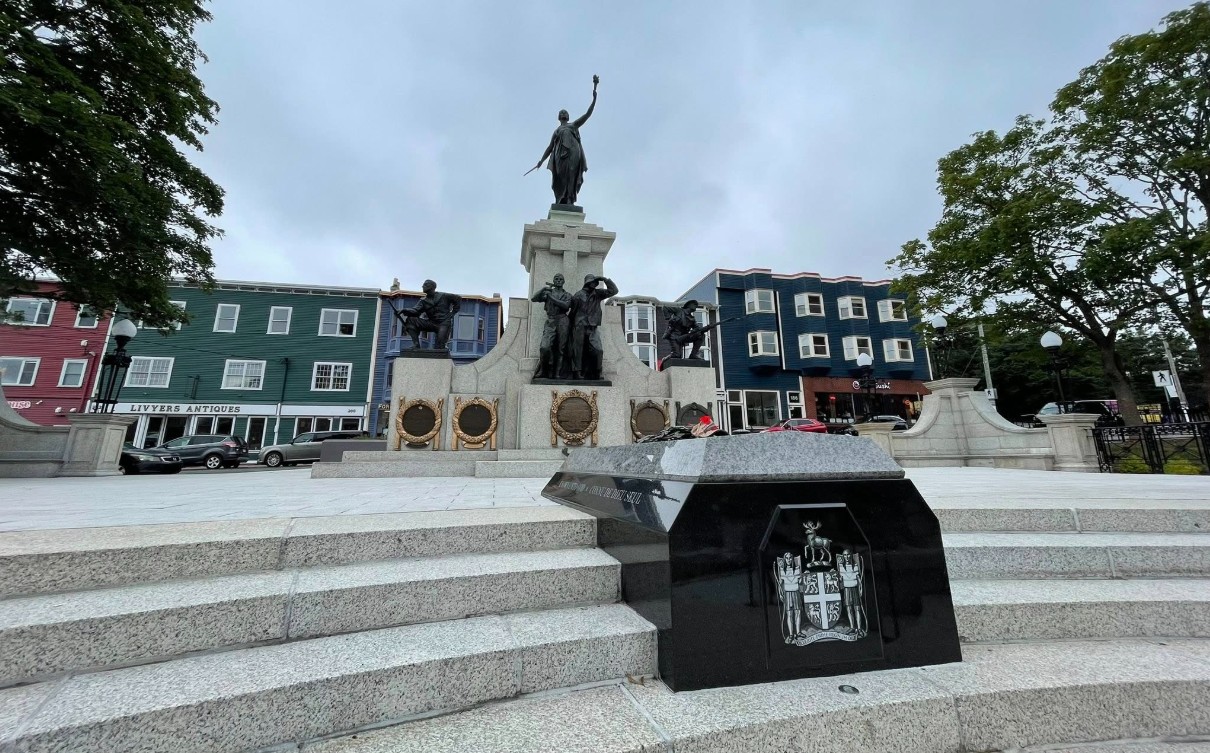
Newfoundland National War Memorial
Honouring a century of Remembrance and the homecoming of an unknown Newfoundland soldier.
Overview
The Newfoundland National War Memorial in St. John’s is one of Newfoundland and Labrador’s most significant places of Remembrance. Officially unveiled on July 1, 1924, it has stood for a century as a tribute to the service and sacrifice of Newfoundlanders and Labradorians in times of war, conflict, engagement, and peacekeeping.
At the time of its creation, Newfoundland was a separate dominion of the British Empire and not yet part of Canada. The memorial was therefore established as Newfoundland’s national war memorial, commemorating Newfoundlanders and Labradorians who served and died during the First World War and in subsequent conflicts.
In 2024, the memorial became the site of another historic moment: the interment of an unknown Newfoundland First World War soldier, repatriated from northern France and laid to rest at the memorial on July 1, Memorial Day in Newfoundland and Labrador.
Key dates
- 1918: Work began toward creating a memorial after the First World War.
- July 1, 1924: The Newfoundland National War Memorial was officially unveiled.
- 2019: The memorial was designated a National Historic Site of Canada.
- May 25, 2024: Repatriation ceremony held in France and arrival in St. John’s.
- June 28–30, 2024: The Unknown Soldier lay in state in St. John’s.
- July 1, 2024: The Unknown Soldier was interred and the memorial was rededicated on its 100th anniversary.
The Memorial
The Newfoundland National War Memorial was officially unveiled on July 1, 1924, by Field Marshal Douglas Haig, former Commander-in-Chief of British forces during the First World War.
The effort to create the memorial began as the First World War was ending. In 1918, the Governor of Newfoundland, Sir Charles Alexander Harris, formed a Commemoration Committee under the Patriotic Association of Newfoundland.
The following years brought delays and challenges, but the memorial was completed under the leadership of Lt.-Col. Thomas Nangle, with support from the Great War Veterans’ Association of Newfoundland and the National War Memorial Committee.
The memorial overlooks St. John’s harbour, the departure point for many who served overseas and the place to which many Veterans returned.
Meaning and Symbolism
Today, the Newfoundland National War Memorial represents the collective sacrifice and service of Newfoundlanders and Labradorians who have served in all branches of service during wars, conflicts, engagements, and peacekeeping efforts.
The monument is built of marble, with bronze statuary and iron fencing. It was the work of British artists Gilbert Bayes and Ferdinand Victor Blundstone.
Bronze plaques on the memorial represent the War of 1812–15, the First World War, the Second World War, the Korean War, and the Afghanistan War.
In 2019, the Newfoundland National War Memorial was designated a National Historic Site of Canada for its artistic significance and because the memorial was inspired by John McCrae’s poem In Flanders Fields.
The Unknown Newfoundland Soldier
During the First World War, Newfoundland was a self-governing dominion of the British Empire and was not yet part of Canada. Newfoundland joined Confederation in 1949.
Approximately 12,000 Newfoundlanders and Labradorians enlisted during the First World War. More than 1,700 lost their lives, and more than 800 have no known grave.
The Unknown Soldier represents the collective contribution and sacrifice of Newfoundlanders and Labradorians who served, fought, and died in military and support services, particularly those with no known grave.
This includes those who served in military, naval, air, and support roles, as well as those who contributed overseas and on the home front.
Repatriation and Homecoming
In May 2024, a special delegation travelled from Canada to France to receive the remains of an unknown First World War soldier from Newfoundland who served at Beaumont-Hamel.
On May 25, 2024, a repatriation ceremony was held at the Beaumont-Hamel Newfoundland Memorial in Auchonvillers, France. The Government of France transferred the remains of the Unknown Soldier to the Government of Canada.
The remains arrived in St. John’s later that day. A hearse carrying the casket followed a ceremonial route from St. John’s International Airport, passing historic sites connected to Newfoundland and Labrador’s First World War military history.
“I was feeling all kinds of emotions even more deeply than I knew I would. I still am.”
— Berkley Lawrence, Immediate Past President, Newfoundland and Labrador Command and First Vice President, Dominion Command (2024)
Lawrence, a Veteran, said witnessing the act of receiving the remains from the French military touched him to the core. His grandfather served during the First World War, including during the Battle of the Somme and later in Gueudecourt, where a memorial now stands in honour of Newfoundland soldiers.
Lying in State
From June 28 to June 30, 2024, the Unknown Soldier lay in state in the East Block Lobby of the Confederation Building in St. John’s. Members of the public were invited to pay their respects.
The lying-in-state formed part of a series of commemorative events that began in France and culminated in the interment and centennial ceremony at the Newfoundland National War Memorial.
Memorial Day and Interment
On July 1, 2024, Memorial Day in Newfoundland and Labrador, the Unknown Soldier was laid to rest at the Newfoundland National War Memorial.
The ceremony also marked the rededication of the refurbished memorial on its 100th anniversary. The remains were reinterred in a custom-designed tomb on the plateau of the memorial.
Following the official ceremonies, the memorial was closed for several hours to allow the cover of the tomb to be placed and fastened. It reopened later that day for the public to pay their respects.
The Legion’s Role
The repatriation initiative was led by The Royal Canadian Legion’s Newfoundland and Labrador Command. The idea came from former Command President and Veteran Frank Sullivan, who believed there was a need to honour all Newfoundlanders and Labradorians who served, including those who remain unknown and rest elsewhere in the world.
“I really felt it was important to Newfoundland and Labrador, and our country, to ensure we never forget the sacrifices made by a significant part of our province’s population during both world wars, up until joining Canada in 1949.”
— Frank Sullivan, Former President, Newfoundland and Labrador Command
Sullivan said the Unknown Soldier would symbolize all those from the province who gave their lives serving in all branches of the military and in respective support services.
“I am deeply moved by the actions of our comrades at Newfoundland and Labrador Command. Their vision and persistence in making this happen will have an enduring and positive impact in that province and also touches citizens from across Canada and beyond.”
— Bruce Julian, Dominion President (2024)
A Lasting Place of Remembrance
With the Unknown Soldier now laid to rest at the Newfoundland National War Memorial, the site has taken on renewed meaning as both a historic memorial and a place where people can honour those who never returned home.
The Unknown Soldier represents Newfoundlanders and Labradorians who served, died, and have no known grave. For descendants and supporters of those who lie in “Known unto God” graves, the memorial now offers a place at home to pay respects.