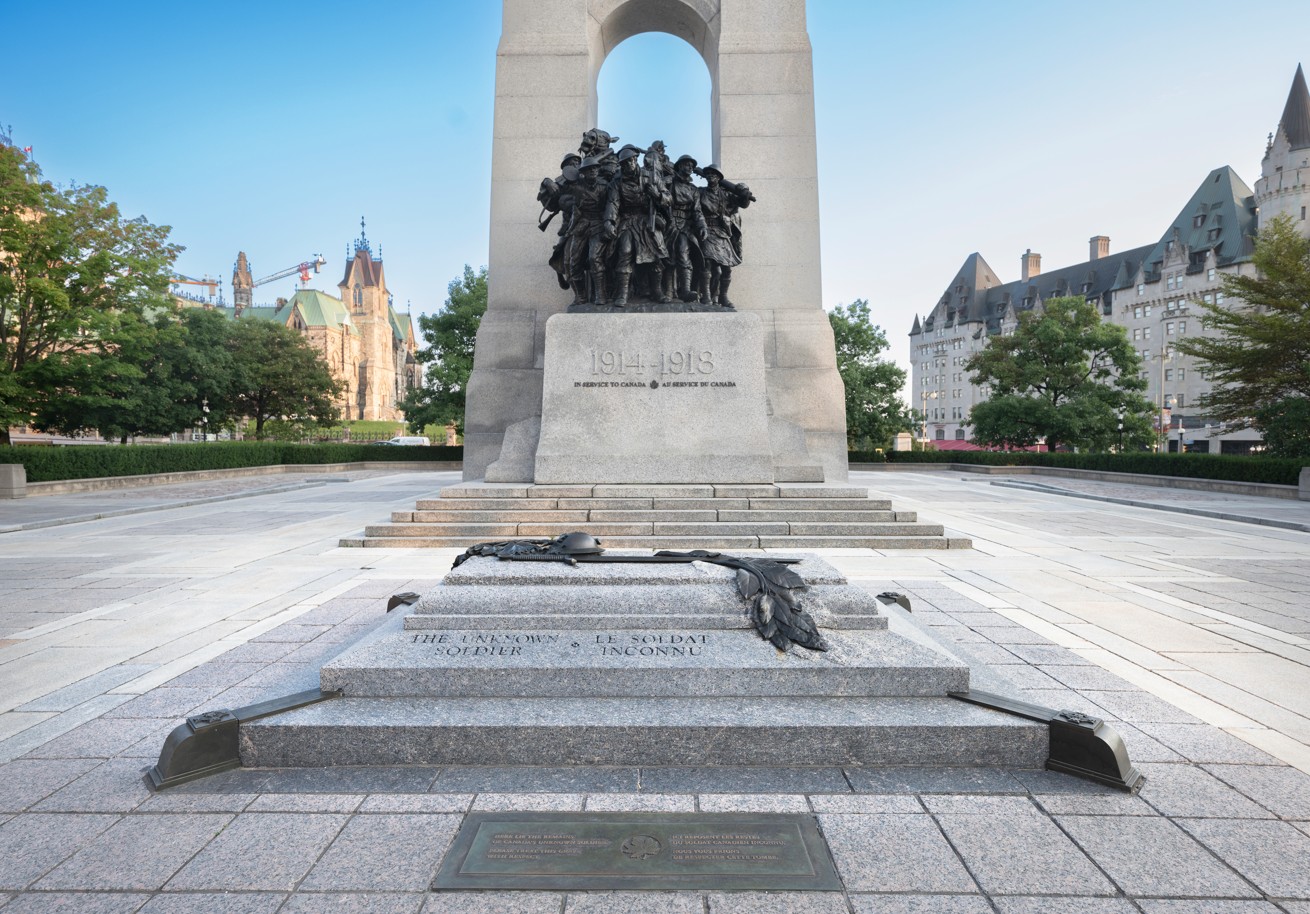
Bringing the Unknown Soldier Home
The story of how Canada’s Unknown Soldier was repatriated and laid to rest at the National War Memorial in 2000.
Overview
In 2000, Canada marked the new millennium with a deeply meaningful act of Remembrance: the return of an unknown Canadian soldier from the First World War to rest at the National War Memorial in Ottawa.
Led by The Royal Canadian Legion, this national effort brought together Veterans’ organizations, government partners, and Canadians from across the country. The Tomb of the Unknown Soldier now stands as a lasting tribute to all who served and died in Canada’s name, especially those whose final resting places are unknown.
The Vision
The idea to repatriate an unknown Canadian soldier was first conceived in 1996 by Brigadier-General (Ret’d) Duane Daly, then Dominion Secretary of The Royal Canadian Legion. Alongside Dominion President Chuck Murphy, Daly helped guide the initiative from concept to reality.
The project was adopted as part of the Canada Millennium Partnership Program, with the goal of creating a national place of remembrance for unidentified Canadian war dead.
Selecting the Unknown Soldier
A key decision was to select the Unknown Soldier from the First World War battlefield near Vimy Ridge, symbolizing a defining moment in Canadian history when all four Canadian divisions fought together under Canadian command.
The Commonwealth War Graves Commission was tasked with choosing the remains.
From more than 1,600 unknown Canadian graves in the region, this soldier was chosen to represent all Canadians who died in service and have no known grave.
Planning the Tomb
To bring the project to life, the Legion convened a national Working Group in 1998. This group coordinated all aspects of the initiative, from selecting the remains to designing the Tomb and organizing ceremonies.
Working Group partners
- Army, Navy and Air Force Veterans in Canada (ANAVETS)
- National Council of Veterans Associations (NCVA)
- Veterans Affairs Canada (VAC)
- Department of National Defence (DND)
- Royal Canadian Mounted Police (RCMP)
- Public Works and Government Services Canada (PWGSC)
- Canadian War Museum (CWM)
- Commonwealth War Graves Commission (CWGC)
- National Capital Commission (NCC)
The Tomb itself was designed as a granite sarcophagus inspired by the Vimy Memorial and constructed using stone from the same quarry as the National War Memorial.
The sarcophagus was designed by Maurice Joanisse, and Mary Ann Liu was selected to create the bronze work.
THE UNKNOWN SOLDIER
LE SOLDAT INCONNU
The Journey Home
The return of the Unknown Soldier unfolded over several days in May 2000 as outlined in the key dates above.
Ceremonies at Vimy
Early on May 25, 2000, the remains of the Unknown Soldier were taken from the Commonwealth War Graves Commission offices at Beaurains to Canadian Cemetery No. 2 at Vimy and placed before the Cross of Sacrifice.
From there, gardeners from Cabaret-Rouge Cemetery carried the coffin to the cemetery gates. It was then taken by hearse to the Vimy Memorial, where a French bearer party placed the coffin on a catafalque at the base of the steps leading to the altar of the Memorial.
Following the ceremony, the coffin was taken to Lille airport and placed aboard a Canadian Armed Forces CC-150 aircraft for the journey to Canada.
Ceremonies in Canada’s Capital
The Canadian Armed Forces aircraft arrived in Ottawa on the afternoon of May 25, 2000. The pilgrimage delegation was met by the Minister of National Defence, the Honourable Art Eggleton, who delivered brief remarks.
The hearse, bearer party, and delegation then proceeded by police-escorted motorcade to the Cartier Drill Hall. Inside, the coffin was placed on a motorized gun carriage and transported to the Peace Tower on Upper Drive.
The bearer party carried the coffin into Centre Block, where it was lowered onto a catafalque in the Hall of Honour. Before the public vigil began, the Governor General and Prime Minister joined the official party. After remarks from the Chaplain General and Governor General, the official party signed the Book of Condolence.
Veterans assembled in the Hall of Honour then approached the catafalque to pay their respects, followed by cadets who were present for the arrival of the Unknown Soldier. The remains lay in state until Sunday afternoon, May 28, 2000.
On May 28, the vigil was dismounted and the coffin was carried from the Hall of Honour, through the arch of the Peace Tower, and placed on a horse-drawn gun carriage provided by the Royal Canadian Mounted Police.
A military procession followed, along with Veterans (uniformed and non-uniformed), and official mourners and dignitaries.
During the interment ceremony, soil from each province and territory was placed within the Tomb, symbolizing a unified act of Remembrance across the country.
At approximately 5 p.m. that day, a large crane was moved into place on Elgin Street to place the cover for the sarcophagus on top of it. The Tomb of the Unknown Soldier was complete.
A Lasting Legacy
The Tomb of the Unknown Soldier was completed on May 28, 2000, and has since become a central feature of Canada’s national Remembrance.
Each year on Remembrance Day, thousands of Canadians place Poppies on the Tomb following the national ceremony, an act of personal tribute and collective memory.
Today, the Tomb stands not only as a monument, but as a powerful symbol of sacrifice, unity, and Remembrance for all Canadians.
For additional historical and procedural details, see Unknown Soldier Project - Archival Record.